What every shop gets wrong about fitting women.
Most fitters haven't fit enough women to see the pattern. These two mistakes cost players comfort, performance, and sometimes the sport itself.
From five years on the shop floor at Ultimate Skate and Hockey, 2018–2023.
The heel pocket problem and how to fix it.
Women's heels average 5–7% narrower than men's relative to forefoot width. Most skate lasts are built on a male foot shape. A standard heat mold leaves the boot relaxing back toward its factory shape as it cools, which leaves measurable gaps in the heel pocket for narrow-heeled feet.
The heel lock wrap forces the boot material to compress closer to the actual foot shape during the cooling window, when the carbon or composite is still pliable enough to hold a new mold.
This technique works on any heat-moldable boot. Standard practice at high-end fitting shops but rarely explained to the player.
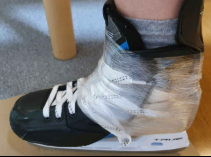
POST-BAKE HEEL LOCK WRAP
Bake the skate per manufacturer specs. Typical: 175°F / 79°C for 3–5 minutes. Always verify with the manufacturer — every boot is different.
Remove skate from oven with a mitt. Slide your foot in and kick your heel firmly into the heel pocket to seat it.
Lace at approximately 75% of normal tension. Pull laces straight outward from each eyelet, not upward, to avoid eyelet damage.
Apply stretch wrap (saran wrap, plastic wrap, or dedicated skate molding wrap) starting at the heel, wrapping up and around the ankle and over the eyelets.
More passes = more compression. Narrow-heeled feet benefit from additional passes to lock the heel pocket tighter.
Sit with knees bent at 90 degrees for 10–15 minutes. Do not stand during this window — standing changes the pressure distribution.
Unlace and let skates cool off-foot for 24 hours before skating. 12 hours minimum if rushed.
Full carbon fiber
True is the gold standard. Carbon holds the new mold aggressively.
Mid-tier composite
Thermoformable shells help but won't lock as tight as full carbon.
Entry-level rec
Non-thermoformable construction. Don't bake these at all.
- ·Verify the skate is heat-moldable before attempting.
- ·A trusted shop tech should do this if you're not confident.
- ·This is a post-bake compression technique, not a substitute for proper sizing.
- ·24-hour cool-down before first skate matters.
Stiffness is about weight, not skill level.
Most shops upsell stiffness based on skill tier. The actual variable is body weight combined with skating volume. This matters more for women because women players on average weigh less than the male players the stiffness ratings were calibrated for.
A 130 lb female competitive player walks in. Shop sees “competitive level, plays 3+ times a week” and steers her toward a pro stiffness boot. The boot is built to flex under a 180–200 lb male player's stride force. At 130 lbs, she can't generate enough force to flex the boot.
Result: the boot feels like a brick. No energy return. Bone bruises. Lace bite. Numbness from over-tightening.
The skate was the problem. Not her.
Stiffness should scale with weight first, volume second, skill level third.
Drop a tier
Under 150 lb, skating 1–4x/week. Go one stiffness tier below what the chart says.
Standard tier
Under 150 lb but 5+ days/week. Stiffer boot defensible for durability.
Charts work
150 lb+ at any volume. Standard charts were calibrated for you.
“What's the rated weight range this boot is designed to flex correctly under?”
“Given my weight and how often I skate, would you actually drop me down a stiffness tier?”
01Can I bake my hockey skates at home?
You can, but proceed with caution. You need an accurate oven (175°F / 79°C, never higher), the correct time for your model (3-5 minutes, check manufacturer specs), and a plan for the wrap and cool-down. If you overshoot temperature or time, you can warp the boot permanently. A pro shop does this for free when you buy from them and they have the right equipment. If you're doing it at home, verify the skate is heat-moldable first — entry-level recreational skates often aren't.
02What is the heel lock wrap technique?
A post-bake compression method where you wrap stretch film (saran wrap, plastic wrap, or dedicated skate molding wrap) around the heel and ankle of a freshly baked skate. The wrap forces the still-pliable boot material to mold tighter to the foot's actual shape during cooling. Particularly effective for women because female heels average 5-7% narrower than what most skate lasts are built for.
03Should I buy hockey skates based on my skill level?
Not exclusively. Stiffness charts use skill level as a proxy, but the actual variable is body weight combined with skating volume. A 130 lb competitive player often performs better in a stiffness tier labeled 'intermediate' or 'performance' because the boot needs her weight to flex it properly. Skill level matters for technique, but weight determines whether the boot physically bends under your stride.
04Why are my hockey skates too stiff?
If you weigh under 150 lb and bought a pro-tier boot, the stiffness rating was likely designed for a 180-200 lb male player. At your weight, you can't generate enough force to flex the boot on each stride. Symptoms: the boot feels like a brick, no energy return, bone bruises on top of the foot, lace bite, and numbness from over-tightening. The fix isn't more break-in time — it's a softer boot.
05How long should I wait after baking skates to use them?
24 hours is the standard. 12 hours minimum if you're rushed. The boot material needs to fully cure in its new shape. Skating on a freshly baked boot before it cures can undo the mold and you'll lose the custom fit you just created.
06Do custom skates fix the stiffness problem?
Yes. True custom, CCM custom, and Bauer MyBauer are all built to the individual player's specifications including weight-appropriate stiffness. They sidestep the chart problem entirely. But at $800-1200+, they're not accessible for everyone. The questions-to-ask-your-fitter approach works for off-the-shelf boots at any price point.
See what we'd recommend for your body.
~90 seconds. Brand-agnostic. We work for the foot, not the brand.
GET MY FIT